Agents move fast. Now they move governed.
Your engineers shipped Copilot, Cursor, Codex. Velocity went up. So did the risk. Intersector is the layer underneath every agent run — supplying the context, policy, and evidence trail your architecture and your auditors expect, across engineering, product, data, ops, and security.
AI is forcing every company to externalize what used to live in people's heads.
For thirty years, how your company actually builds and operates has lived in tribal memory — ADRs nobody wrote, owners everyone "just knew," decisions made in hallway conversations, standards passed down by osmosis.
Agents can't read any of that. They execute on what's written down. The companies that win this decade are the ones that make their operating model explicit — versioned, queryable, enforceable. Everyone else will keep paying the cost of agents shipping code that violates rules nobody documented.
- “Ask Maria, she owns that service”
- “We decided not to do that — I think it’s in a Slack thread”
- “The standard is whatever the senior engineer approves”
- “Everyone knows we don’t deploy on Fridays”
- Owner field on every service, queryable by any agent
- ADR-017, versioned, linked to the services it governs
- Scorecards that block promotion when standards fail
- Policy-as-code, enforced before merge, logged after
Governance that depends on people doesn't scale
Stop selling tools to your teams. Start putting governance underneath every tool they already ship with.
Enterprises are consolidating onto platforms that orchestrate humans, bots, and AI agents. Governance is the layer they're missing.
Business orchestration and digital process automation are converging into a single control plane where work runs across people, RPA bots, APIs, and autonomous agents. These platforms are becoming the execution brain of the enterprise. But orchestrating execution and proving it are not the same thing — and governance is consistently where they score weakest. Intersector is the layer underneath every run: grounded in your real architecture, checked against your policy, logged audit-ready by default.
Orchestrated by them. Governed by you.
Every human, bot, and AI agent action runs under one policy set and one audit trail — not five disconnected consoles.
One substrate, not another silo.
60+ entity types across 5 domains become the shared source of truth your orchestration, automation, and agent platforms read from.
Provable, not just automated.
Guardrails block promotion before merge; evidence is captured after deploy. Compliance stops being a quarterly scramble.
Intent. Context. Evidence. The three inputs Intersector supplies to every agent run.
An agent reading a Jira story has 280 characters of context and your hope. Intersector turns your standards, decisions, and architecture into a governed substrate that IntentOps tools — like Exploration OS — read from on every run.
Versioned intent agents can execute against
Capture objective, expected outcomes, decisions, risks, and acceptance criteria as a versioned artifact — not a 280-character ticket. The substrate IntentOps tools read from when they run.
The knowledge graph the agent reads first
ADRs, services, owners, dependencies, policies, postmortems — 60+ entity types in one graph. Every execution pack is assembled from real architectural memory, not a vector-search prayer.
Guardrails before merge. Audit after deploy.
Policy checks block promotion until requirements pass. Spec-code drift detection catches what the agent silently changed. Every approval, override, and exception — logged, exportable, audit-ready by default.
Everywhere your company executes. One governed layer across every domain.
Engineering, product, data, operations, security — one execution layer, one audit trail, one source of truth. No new silos. No rip-and-replace.
Engineering
Track decisions, debts, and system structure
Product
From roadmap to release, connected to real services
Data
Sources, products, and BI assets in one catalog
Operations
SLAs, costs, certificates, postmortems, readiness
Security
Policies, risks, pen tests, and remediation tracking
How Intersector works
Map your landscape. Set the rules. AI agents enforce them continuously.
Map your landscape
Import your architecture from Draw.io, CSV, or build it interactively. Services, databases, APIs, queues — all connected in a live topology map.
Set governance guardrails
Define scorecards that auto-check compliance. Set guardrail policies as quality gates. Track deliverables from draft through review to done.
Execute & prove
Humans and AI agents deliver work under your rules across code, chat, tickets, and tools. Every action is traceable. Every policy is enforced. Every outcome is audit-ready by default.
Not a tool for governance teams. A governance team.
Traditional platforms give your team dashboards and hope someone acts on them. Intersector deploys 25 AI agents that do the governance work: enforcing compliance, catching drift, triaging debt, optimizing costs. Every finding goes through an approval workflow. Your architects review and accept — they don't do the scanning, analysis, and cross-referencing. The agents do.
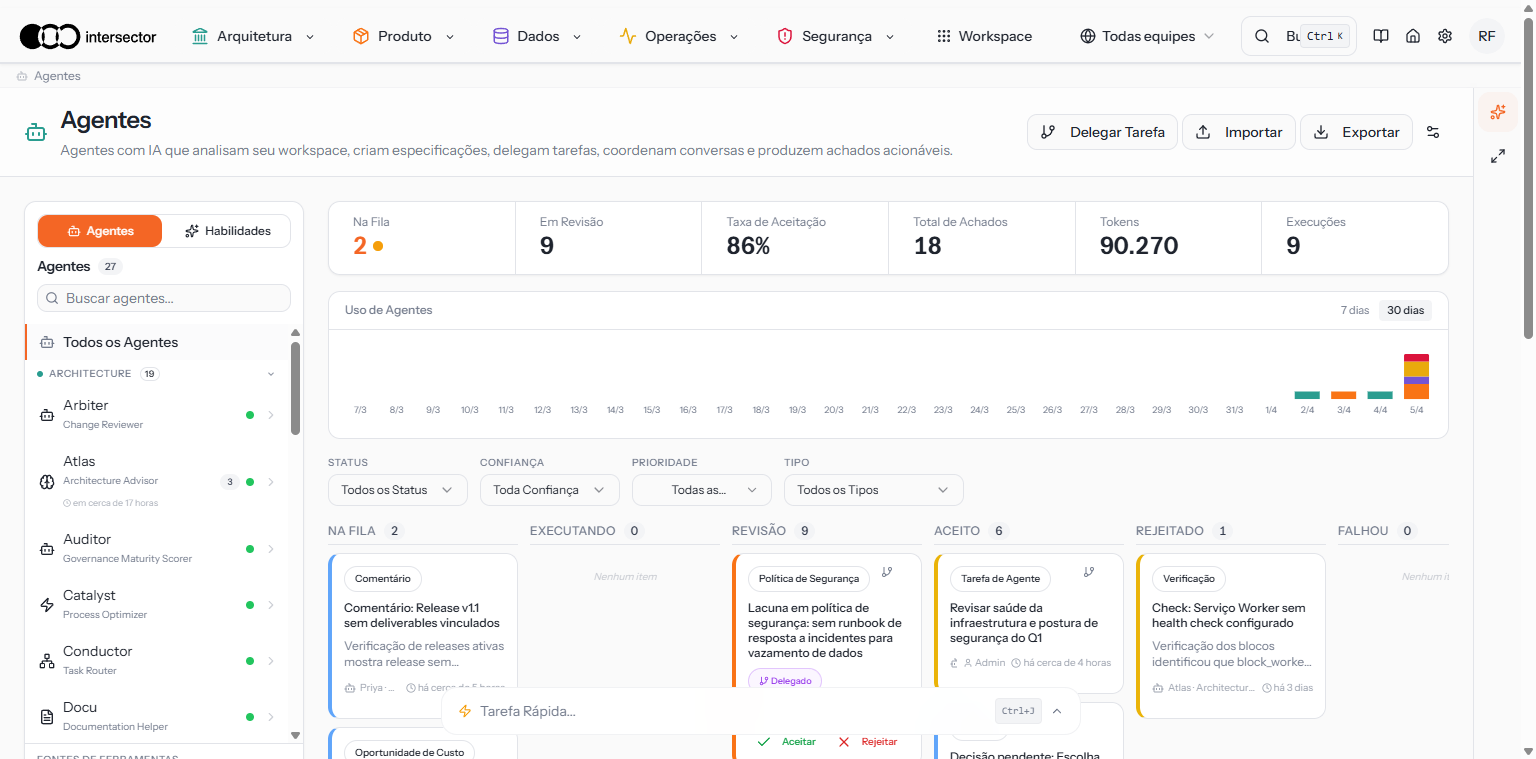
Guardian
Compliance MonitorRuns scorecards, detects violations, creates prioritized remediation as tech debt.
Sentinel
Drift DetectorFinds missing owners, stale health checks, undocumented services, orphaned blocks.
Reaper
Staleness AuditorIdentifies stale entities across all domains. Recommends cleanup or archival.
Costkeeper
FinOps AnalystAnalyzes cost data, flags orphan cloud accounts, tracks savings opportunities.
Weaver
Dependency AnalystDetects single points of failure, circular dependencies, and high fan-out risks.
Arbiter
Change ReviewerInstant first-pass review when new checks or RFCs are created.
Bridge
Incident PipelineEnriches postmortems with architecture context. Generates action items as debt.
Herald
Change BroadcasterIdentifies affected teams when changes are approved. Broadcasts impact summaries.
Mentor
Onboarding GuideGenerates personalized orientation when new team members join.
Forge
SDD PractitionerCreates governance-ready specs using Spec-Driven Development methodology.
Atlas
EngineeringReviews RFCs against existing decisions. Flags contradictions and gaps.
Priya
ProductDrafts initiative specs grounded in your actual service catalog.
Dara
DataChecks data product docs for completeness and lineage gaps.
Kai
OperationsWrites postmortem templates pre-filled from your SLA and incident data.
Sentry
SecurityMaps risk entries to affected services and tracks remediation deadlines.
Create your own agents and teach them skills — point at any OpenAPI spec and Intersector generates the integration code.
Every teammate connects their own AI. With their own permissions.
One command connects Claude Code, Cursor, or Windsurf to your governance layer over MCP. No shared service accounts, no admin bottleneck.
Your key. Your permissions.
Each user's AI operates under their own RBAC — read/write per entity type, deny by default. Exactly what they'd see in the app, nothing more.
Agents propose. Policies decide.
Writes that match an approval policy pause for human review. Every call is attributed, rate-limited, and account-isolated.
Connected in under a minute.
Generate a key in your profile, paste one command, and your assistant can search, brief, and act across hundreds of governance tools.
Connect everything. Automate the rest.
Pull data from your cloud providers, FinOps tools, and observability platforms. Let Intersector keep your governance map automatically synchronized.
Cloud Cost
AWS, Azure, GCP, OCI cost data
FinOps Tools
Optimization & allocation platforms
Observability
Metrics & monitoring systems
Data Import
Custom integrations & webhooks
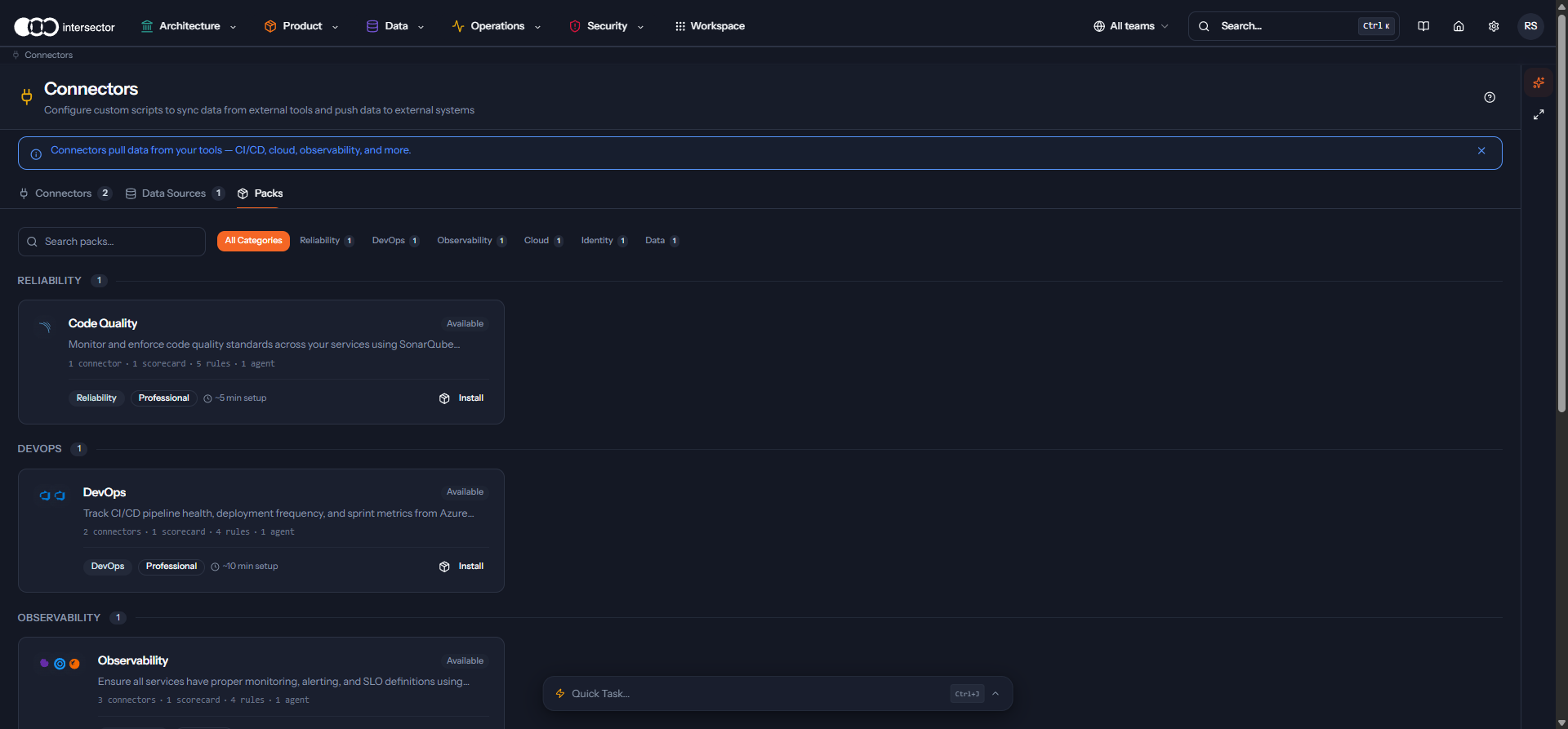
See it in action
Live service topology with health signals
Explore your entire service landscape with zoomable, filterable maps. Health indicators surface degraded services instantly. Click any node to see dependencies, owners, debts, and SLAs.
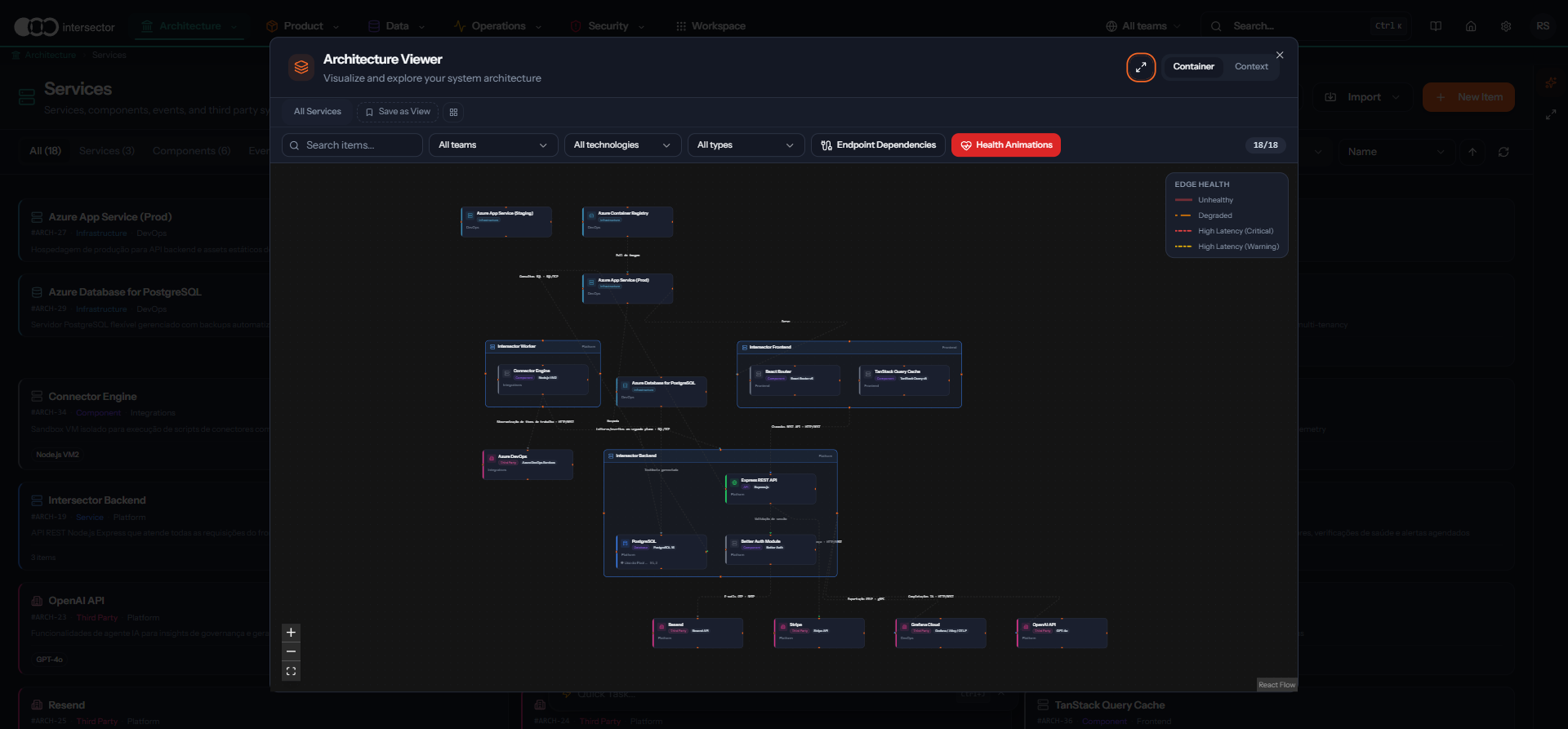
Automated compliance scorecards
Define rules that auto-evaluate every service against your standards. Failing checks automatically create remediation tasks. Track pass rates across your entire portfolio and close the compliance loop without manual work.
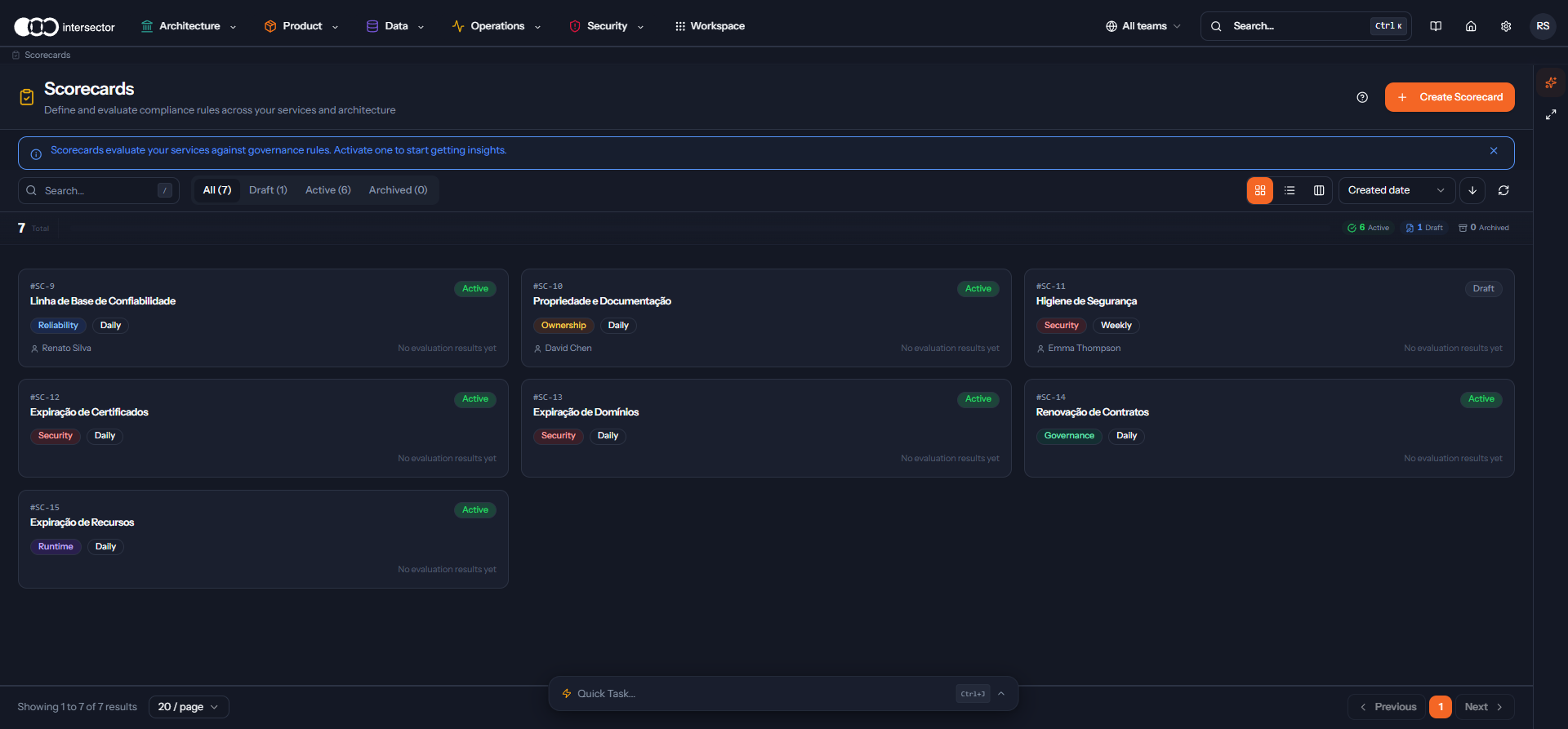
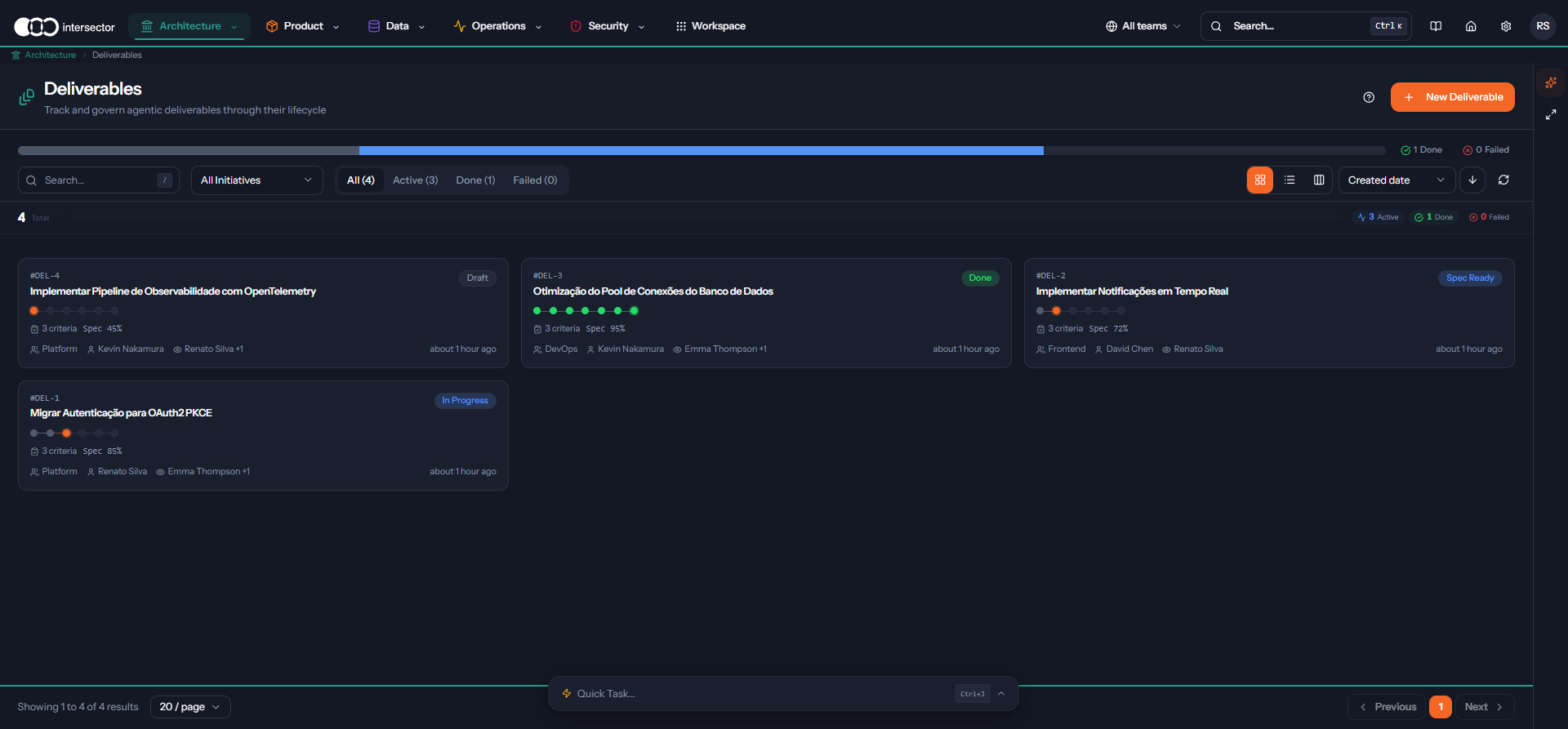
Deliverables with guardrail policies
Deliverables move through stages. Guardrail policies block promotion until requirements pass. Reviewers give per-criterion verdicts. Outcome checks verify nothing regressed after release.
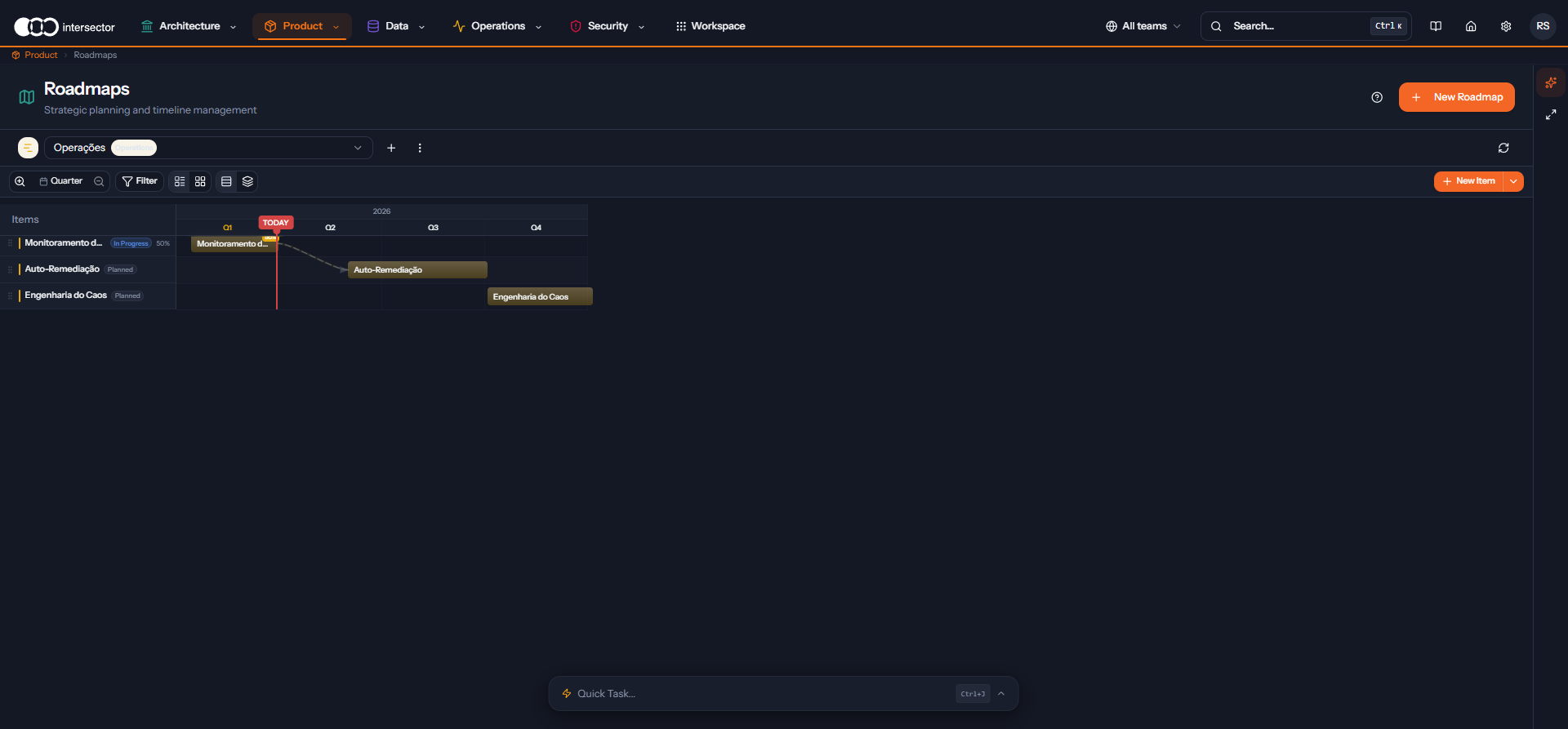
Strategic roadmaps with prioritization
Gantt charts with swimlanes and dependency tracking. Score initiatives using RICE, WSJF, or Impact vs. Urgency frameworks. Trace any roadmap item back to the team and service that owns it.
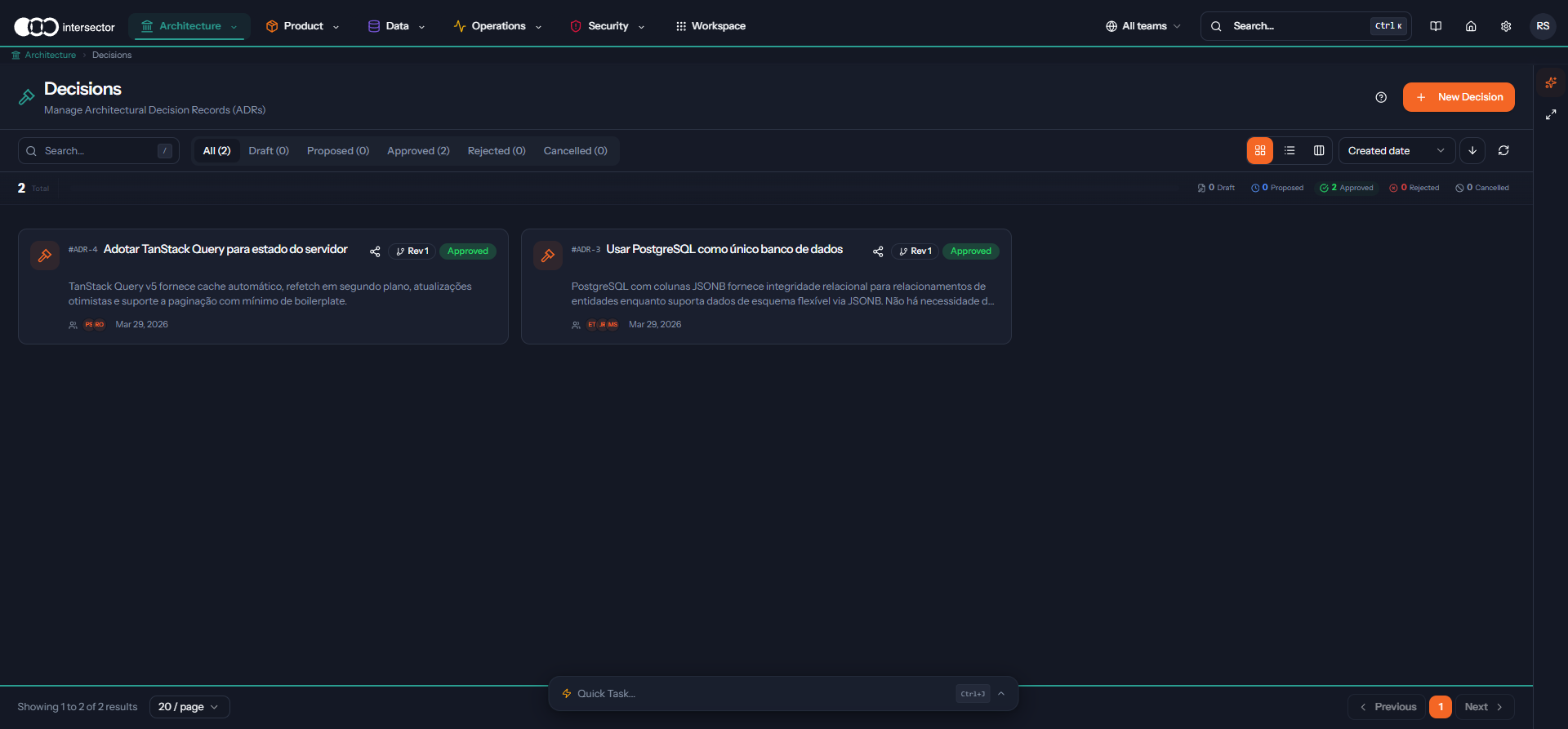
RFC and ADR management
Capture technical proposals, track discussions, and document decisions with full revision history. Link every decision to the services and teams it impacts.
Custom dashboard builder
Drag-and-drop widgets powered by JavaScript expressions. Build executive views, team dashboards, or operational monitors. Kiosk mode for wall-mounted displays. Five built-in domain dashboards included.
Autonomous governance agents
25 built-in agents organized in 4 tiers — plus create your own. Schedule-triggered agents continuously audit compliance, detect drift, and analyze costs. Event-triggered agents react to changes in real time. Teach agents new skills by pointing at any OpenAPI spec. Every finding goes through an approval workflow before taking effect.
Built for enterprise reality
Authentication, permissions, audit, integrations, and billing — all production-ready from day one.
SSO & Authentication
Email OTP, OIDC SSO (Google, GitHub, custom IdP), OAuth social login, multi-account support
Granular RBAC
Role-based permissions across 60+ entity types with read/write/admin granularity per team
Data Import
CSV import/export, Draw.io diagram import, Markdown import — bring your existing data instantly
Playbook Automation
Codified governance playbooks with automated steps, approval policies, and webhooks for external systems.
Full Audit Trail
Every create, update, and delete logged with user, timestamp, and before/after snapshots
Multilingual
Full English and Portuguese (pt-BR) support. Interface and all entity labels fully translated.
Built for regulated enterprises
Every action logged. Every policy versioned. Every decision traceable. Intersector gives your compliance and legal teams the evidence they need.
Complete Audit Trail
Every change — who, when, what, before/after — logged automatically. Export audit reports for internal or external audits in seconds, not days.
Versioned Security Policies
Create, review, and approve security policies with full version history. Map policies to services and track compliance status across your portfolio.
Automated Compliance Scoring
Define compliance rules as scorecards. Auto-evaluate every service on schedule. Failing checks create remediation tasks automatically — closing the compliance loop.
Enterprise Access Control
SSO via OIDC, granular role-based permissions across 60+ entity types, and team-scoped access. Meet your identity provider requirements from day one.
Risk Register & CTEM
Centralize risks with CVSS and business impact scoring. Track penetration tests, remediation deadlines, and vendor security assessments in one place.
Vendor & Contract Governance
Track vendor contracts, SLA commitments, certificate lifecycles, and cloud account inventory. Never be surprised by an expiring contract or certificate again.
Frequently asked questions
What is Intersector? +
How is Intersector different from wikis or documentation tools? +
What teams benefit most from Intersector? +
How does Intersector handle security and access control? +
Can Intersector replace our existing tools? +
How do we get started? +
How does Intersector help with compliance and legal requirements? +
Can we start with just one governance domain? +
How do similar enterprises use governance platforms? +
How do the AI agents work? +
For every dollar spent on governance tools, six are spent on the people doing governance work.
What if governance just happened?
Request a beta invite. Deploy your first AI governance agent within the first hour.
Prefer email? sales@intersector.io